

HOME
Cross-Border Mobility: Migration, Logistics and Geopolitics
T2M the International Association for the History of Transport, Traffic and Mobility
Győr, Hungary – October 14-17, 2026
The Széchenyi István University in Győr is pleased to invite you to Cross-Border Mobility: Migration, Logistics and Geopolitics of T2M the International Association for the History of Transport, Traffic and Mobility. The conference aims to provide an academic platform for researchers, professionals, policymakers, and stakeholders to present their work and research on the history of mobility and its contemporary human implications. By fostering collaboration and adopting multidimensional approaches, the conference seeks to identify pathways toward a more inclusive, resilient, and sustainable future mobility.
T2M Conference
Győr, 14-17 October 2026
Széchenyi István University
Until the start of the conference
Contact
E-mail address:
t2m2026gyor@gmail.com
Submission Information
Authors are invited to submit abstracts (300 words) or full papers (8000 words) for presentation at the conference. Selected papers may also be published in Scopus/WoS-indexed journals. The official language of the conference is English.
aim and scope
Following the First World War and the dissolution of the major empires, the imposition of rigid borders and systematic controls fundamentally restructured global transportation during the early twentieth century. This shift fragmented existing transport infrastructure as nations prioritised border sovereignty. Throughout the twentieth century, global shifts fundamentally reshaped cross-border mobility: international migration, trade, and logistics became deeply entangled with geopolitical interests, security, and economic strategy. Borders evolved from mere dividing lines into complex zones of regulation where state and non-state actors exert influence. Conversely, transport infrastructures often serve as a bridge; these cross-border systems facilitate cooperation and align the political and economic interests of neighbouring states. Within entities like the Soviet Union, the European Union, or the United States, these networks act as vital social, economic, and cultural arteries.
Cross-border mobility is a foundational force in human history. For centuries, the movement of people, resources, ideas, and power has shaped societal development, economic systems, and the spatial logic of states and empires. This conference seeks to examine these dimensions of mobility through both historical and contemporary lenses, focusing specifically on the intersection of migration, logistical infrastructure, and geopolitical strategy.
Mobility is more than mere physical movement; it is a social and political construct shaped by legal frameworks, technological capabilities, power dynamics, and cultural narratives. Analysing mobility allows researchers to cast new light on the evolution and current status of state borders and centre-periphery relations, revealing the specific mechanisms used to incentivise, restrict, or monitor human and material flow.
The conference emphasises that migration is never an isolated phenomenon; rather, it is deeply embedded within logistical and geopolitical contexts. The evolution of transport networks, trade routes, supply systems, and administrative structures has fundamentally dictated the direction, intensity, and social impact of human movement. Conversely, these migration patterns have actively reshaped geopolitical strategy, border enforcement, and the mechanisms of spatial control.
The conference is broad in its chronological scope: we invite proposals spanning the pre-modern, early modern, and modern eras, through to the twentieth and twenty-first centuries – a period defined by global conflicts and upheavals. We especially encourage contributions that adopt longitudinal approaches, theoretical proposals, comparative frameworks, or transnational perspectives.
This conference provides an interdisciplinary forum to examine the historical and contemporary dynamics of cross-border mobility. We invite contributions from historians, sociologists, humanities scholars, and international relations experts, as well as economists, legal scholars, engineers, and artists. We also welcome the perspectives of policymakers and educators. We particularly value presentations grounded in empirical research, comparative frameworks, or critical theoretical approaches that interrogate the nexus of migration, global logistics, and geopolitical strategy.
The conference welcomes submissions on a broad range of topics, including but not limited to:
- migration systems and population movements
- imperial, state and private logistics: the history, heritage, present and sustainability of roads, ports, railways, infrastructure, local transportation systems and warehouse networks
- the geopolitical significance of trade and transit routes
- military mobility, military supply and war logistics
- forced mobility: deportations, flight, resettlements, climate/environmental inequalities
- mobility, identity and border regions
- historical and current changes in geopolitical thinking and spatial perception
- socialist and post-socialist mobilities
- the relationship between mobility and state sovereignty
- the role of transport infrastructure in regional and cross-border integration
- global supply chains, logistics and infrastructure
- the impact of geopolitical conflicts and crises on mobility
- legal, economic, architectural and artistic aspects of cross-border mobility
- digitalisation, technology and new forms of mobility
The conference aims to foster rigorous scientific dialogue and interdisciplinary cooperation by bridging theoretical research with practical experience. We invite applications from both domestic and international scholars and practitioners. While we welcome all contributions related to the conference’s core themes, we particularly encourage proposals for organised panels and thematic sessions. A limited number of travel grants will be available for participants who lack institutional funding, with priority given to those from low-income countries.
DEADLINES AND FEES
IMPORTANT DATES AND DEADLINES
Deadline for the submission of abstracts
Notification of acceptance for abstracts
Submission for travel grant closes
Early Bird registration opens
Notification of acceptance for travel grant
Early Bird registration closes
Registration for presenting closes
Registration for attending closes
Submission of full papers and posters
registration and fees
Registration is open from early August 2026.
| Title of Fee | Fee (€) | Registration Period |
|---|---|---|
| Early Bird T2M Member | 240,00 | Early August – 31 August |
| Early Bird T2M Member Reduced | 200,00 | Early August – 31 August |
| Early Bird Non-T2M Member | 270,00 | Early August – 31 August |
| Early Bird Non-T2M Member Reduced | 240,00 | Early August – 31 August |
| Regular T2M Member | 270,00 | 1 September – 13 September |
| Regular T2M Reduced | 220,00 | 1 September – 13 September |
| Regular Non-T2M Member | 360,00 | 1 September – 13 September |
| Regular Non-T2M Member Reduced | 310,00 | 1 September – 13 September |
| Late Fee T2M Member | 290,00 | 14 September – 30 September |
| Late Fee T2M Reduced | 240,00 | 14 September – 30 September |
| Late Fee Non-T2M Member | 380,00 | 14 September – 30 September |
| Late Fee Non-T2M Member Reduced | 330,00 | 14 September – 30 September |
Travel Grant and Prize
Please note that we offer several travel grants for academics from the Global South and for PhDs/Master students. The application form is available below and the deadline for applications is 20 July 2026. We aim to notify applicants by 10 August 2026.
John Scholes Prize
Applications to the John Scholes Prize are welcome. For more information on this award, please visit here.
committees
THE CONFERENCE BOARD
Dr. habil. Csaba Sándor Horváth
Széchenyi István University Apáczai Csere János Faculty of Education, Humanities and Social Sciences
chair of the conference
Programme Committee
Hugo Silveira Pereira
Olha Martynyuk
Lyubomir Pozharliev
Jinhyoung Lee
Tomáš Nigrin
David Julien Walthall
Local Organising Committee
Csaba Sándor Horváth
Chair of the Program Committee
Ágoston Winkler
András Veöreös
Balázs Horváth
Balázs Varga
Gábor Kecskés
Júlia Hajszán
Júlia Szőke
Katalin Bándy
Nóra Horváth
Péter Németh
Zoltán Ködmön
Attila Pongrácz
submission
After acceptance, all abstracts will be published on the conference website. You will also have the opportunity to submit a full paper (8,000 words). Submission of full papers is not mandatory but strongly recommended, and they will be shared with all conference participants.
The conference has a special focus on all four T2M journals – Mobilities, Transfers, Journal of Transport History and Mobility Humanities. Special sessions in relation to them and publishing opportunities will be organised. Selected papers may form part of Special Issues of the T2M journals.
publishing
Selected paper
Papers intended for publication should be submitted directly to the partner journals. Please read the ‘Aims and Scope’ section of each journal and select the one that best suits your topic. Submissions are now open and the process is handled individually; therefore, the conference organising committee takes no responsibility for the submission or publication of the papers. The acceptance and publication of a paper are solely at the discretion of the journal.
partner journals
Mobilities (Routledge) – Scopus Q1
Mobilities examines the large-scale movements of people, objects, capital, and information across the world, as well as more local processes of daily transportation, movement through public and private space and the travel of material objects in everyday life. New transportation and digital infrastructures and novel social and cultural practices pose important challenges for coordinating and governing mobilities and for mobility rights and questions of ‘access’. These ‘mobility’ issues have generated new research methods and theories. Mobilities publishes original, theoretically-informed research which is international in scope. The journal addresses major topical issues and fosters scholarly debate around the ‘mobility’ turn. Papers in the following areas would be considered for publication in Mobilities: Mobile spatiality and temporality; Sustainable and alternative mobilities; Mobile rights and risks; New social networks and mobile media; Immobilities and social exclusions; Tourism and travel mobilities; Migration and diasporas framed in terms of wider mobilities theory; Transportation and digital technologies; Transitions in complex systems; Climate change and transportation energy.
Journal of Transport History (Sage Publication Inc.) – Scopus Q1
The Journal of Transport History aims to circulate and promote the best and the widest possible range of peer reviewed analysis and commentary on all facets of transport pasts. It also aims to benchmark and stimulate the craft of researching, curating and writing transport history in all its diversity. It seeks to challenge received wisdom, to provoke debate, and to open new frontiers of inquiry.
Mobility Humanities (Konkuk University) – Scopus Q2
Mobility Humanities is a peer-reviewed, international and interdisciplinary journal published two times per year by the Academy of Mobility Humanities at Konkuk University, Seoul, South Korea. While seeking vibrant interdisciplinary discussions on the phenomena, technologies, and infrastructures of mobility and its ramifications from the humanities perspective, Mobility Humanities encourages papers that delve into their cultural-political, ethical, and spiritual and emotional meanings, focusing on the representation, imagination, and speculation that surround mobility. Mobility Humanities welcomes original articles that make an innovative contribution to the humanities-based mobility studies from philosophical thoughts, literary, cultural and communication inquiries, historical, geographical, and sociological research around the world. We especially welcome research from and about Asia and the Global South. Mobility Humanities consists of articles, creative/visual essays, book reviews, scholarly interviews or dialogues, as well as special issues.
Transfers: Interdisciplinary Journal of Mobility Studies (Berghahn Books Inc.) – Scopus Q4
Transfers: Interdisciplinary Journal of Mobility Studies is a peer-reviewed journal publishing cutting-edge research on the processes, structures, and consequences of the movement of people, resources, and commodities. Intellectually rigorous, broadly ranging, and conceptually innovative, the journal combines the empiricism of traditional mobility history with more recent methodological approaches from the social sciences and the humanities. The journal’s scholarly articles, book and exhibit reviews, and artwork and photography, as well as special features, provide a rich variety of perspectives that include: analyses of the past and present experiences of vehicle drivers, passengers, pedestrians, migrants, and refugees; accounts of the arrival and transformation of mobility in different nations and locales; and investigations of the kinetic processes of global capital, technology, chemical and biological substances, images, narratives, sounds, and ideas. Convened around a broad conception of mobility, Transfers provides an interdisciplinary platform to explore the ways in which experiences of mobility have been enabled, shaped and mediated across time and through technological advances.
Keynote Speakers
We are very pleased to confirm the following keynote speakers for T2M 2026
Peter Adey - CV
Peter Adey (PhD) is Professor of Human Geography and Head of Human Geography, Anthropology and Development Studies at Monash University. Peter works on the cultures, aesthetics and security of mobility, is a co-editor of the journal Mobilities, and the author of books such as Mobility (Routledge); Aerial Life: spaces, mobilities, affects (Wiley); and Evacuation: the politics and aesthetics of movement in emergency (Duke UP).
Nóra Horváth - CV
Nora Horvath PhD, habil. is a philosopher, art critic, dramaturg, Editor-in-Chief and Managing Director of the Hungarian cultural journal Műhely, and Associate Professor at Széchenyi István University in Győr, Hungary, where she has been teaching for twenty years. Her university courses include Aesthetics, Art and Creative Industries, Contemporary Art Theories, Philosophy, and Design and Ethics. She earned her PhD in Philosophy in 2014. Her dissertation—dedicated to the theory of the aesthetics of existence through an in-depth analysis of the oeuvre of three American philosophers and artists—was published as a book in Hungarian in 2019 under the title “Lovers of Beauty: George Santayana and His Contemporaries”. The material of her habilitation, completed in 2022 at the Doctoral School of Philosophy at the University of Pécs, falls into the genre of the philosophy of dance. Since 2001, she has regularly published art and literary criticism, since 2005, she has been a frequent presenter at national and international conferences. Among these, she considers her lecture at the 2018 World Congress of Philosophy in Beijing and her presentation on Tibor Hajas’s performances at Fudan University (Shanghai) during a 2017 aesthetics conference dedicated to avant-garde art as particularly memorable experiences. She believes that philosophizing—philosophy itself (“the love of wisdom”)—is synonymous with being on a journey, making it the most ancient form of intellectual mobility. This is particularly exciting in today’s digital age, when mobility becomes detached from the physical body.
Ágoston Winkler - CV
After completing his studies at the Budapest University of Technology and Economics, Ágoston Winkler worked for 17 years, starting in 2005, at the Győr-based public transportation company Kisalföld Volán and its legal successors. He participated in the development and implementation of numerous public transportation network reforms, the modernization of passenger information systems in Győr and Sopron, and developed the online schedule information system called MenetRendes, which was later adopted in 17 cities. In 2007, while working at Volán, he joined the Department of Transportation at Széchenyi István University in Győr as a doctoral student, he received his PhD in 2013, and since 2020 he has been working as an associate professor, where he is responsible, among other things, for teaching and developing the courses Passenger Transport, Passenger Transport Companies, and Public Transportation. He is a committed advocate and expert of public transportation. His research areas include the planning of urban public transportation networks and schedules, the discovery of passenger preferences, the development of passenger information systems, and the history of local transportation. He considers the popularization of public transportation to be important and has been one of the main organizers of the European Mobility Week program series in Győr since 2007.
Tomáš Nigrin - CV
As. Prof. Tomáš Nigrin (1981) studied Area Studies, German Studies and Modern History at the Charles University in Prague, Free University Berlin, Humboldt University Berlin and Heinrich Heine University Düsseldorf. His research interest covers German post-war history, current political development in Germany and history of transportation and was participating in many national and international research projects. He spent two months in 2022 as a research fellow at the Research Centre for the History of Transportation at the University of Vienna, was a visiting professor at the University Regensburg (2025) and lecturer at the universities in Vienna, Cologne and Tbilisi. Tomáš Nigrin currently director of the Institute of International Studies at the Faculty of Social Sciences, Charles University, and member of the rector´s collegium for strategic development of the Charles University.
conference venue
Széchenyi István University, Apáczai Csere János Faculty of Humanities, Education and Social Sciences, 9022 Győr, 42 Liszt Ferenc street
Programme
Preliminary Programme
Venue: Széchenyi István University, Apáczai Csere János Faculty of Humanities, Education and Social Sciences, 9022 Győr, 42 Liszt Ferenc street
14 October 2026
9:00-10:00 Registration
10:00-10:15 Opening and Welcome Speech
10:15-12:15 Keynote Presentations
12:15-14:00 Networking and Lunch
14:00-17:00 Parallel Sessions
18:00- Gala Dinner and Networking
15 October 2026
8:00-9:00 Registration
9:00-12:00 Parallel Sessions
12:00-13:30 Networking and Lunch
13:30-16:30 Parallel Sessions
16 October 2026
8:00-9:00 Registration
9:00-12:00 Parallel Sessions
12:00-13:30 Networking and Lunch
13:30-14:00 Closing Session
14:00-18:00 Social Programmes (City tour, Audi factory)
17 October 2026
8:48-13:43 A journey on the fabulous 19th Century Cuha Valley Railway, including a short walk (1,5 hours and 5 km). The programme begins and ends at Győr’s railway station.
Travel and Accomodation
We are looking forward to welcoming you to Győr, Hungary, for the T2M Annual Meeting 2026, taking place on 14–17 October 2026.
To help you plan your journey and stay, we have collected some useful information on travelling to Győr, accommodation and local transport.
Venue
Széchenyi István University, Apáczai Csere János Faculty of Humanities, Education and Social Sciences, 9022 Győr, 42 Liszt Ferenc Street. The venue is approximately a 15-minute walk from both Győr railway station and the main bus station, or around 5 minutes by taxi.
To help you plan your journey and stay, we have collected some useful information on travelling to Győr, accommodation and local transport.
Győr is conveniently located between Budapest, Vienna and Bratislava and is easily accessible by train, bus and car.
Approximate travel times to Győr:
- from Vienna International Airport (Schwechat): 1.5 hours
- from Bratislava: around 1–1.5 hours
- from Budapest: approximately 1.5 hours
From Vienna International Airport
There are several convenient options for travelling directly from Vienna Airport to Győr.
By direct FlixBus:
FlixBus currently operates 2 direct services per day between Vienna International Airport and Győr. The journey takes approximately 1.5 hours, and tickets currently start at around €11.98. As departure times and prices may vary depending on the travel date, we recommend checking the FlixBus website or mobile application before travelling.
By train:
Train connections from Vienna International Airport to Győr are also available. Tickets and current timetable information can be found on the ÖBB website or in the ÖBB mobile application.
From Bratislava Airport
Slovak Lines Express line 102838 provides a convenient direct connection between Bratislava Airport and Győr.
The service operates 6 times per day in each direction, every day including weekends. The journey from Bratislava Airport to Győr takes approximately 1 hour, with online fares currently starting from €7.90. Prices may vary depending on the selected departure and booking date.
Tickets can be purchased online through Slovak Lines or via the Slovak Lines mobile application. The service arrives at Győr Bus Station, which is approximately a 15-minute walk from the conference venue.
From Budapest
For journeys from Budapest to Győr, train tickets can be purchased through the MÁVPlusz application or online.
Passengers arriving at Budapest Liszt Ferenc International Airport can take the 100E Airport Express bus to Kálvin tér, continue by metro line M4 to Budapest-Kelenföld railway station, and take a train from there directly to Győr.
Please note that a separate airport bus ticket is required for the 100E Airport Express!
Train tickets can generally be purchased online or from ticket machines shortly before departure, so booking several weeks in advance is not compulsory. However, passengers must have a valid ticket before boarding regional trains.
Advance online booking is recommended, as it may offer lower fares and makes it easier to reserve a seat. Seat reservations are optional on most daytime services but are recommended during busy travel periods.
For further useful information about travelling to Hungary, visas and arrival procedures, click here.
Accommodation
Győr offers accommodation for a wide range of budgets, with all of the options below located within walking distance or a short bus ride from the conference venue.
4★ Hotels
- Hotel Famulus (Széchenyi István University) – approx. €100/night with breakfast – 5-minute walk
- RQ Boutique & Unique Hotel – approx. €95/night with breakfast – 15-minute walk
- Barokk Hotel Promenád – approx. €100/night with breakfast – 10-minute walk
3★ Hotels
- Ibis Győr – approx. €80/night with breakfast – 10-minute walk
- Fonte Hotel – approx. €76/night with breakfast – 10-minute walk
- Danubius Hotel Rába – approx. €83/night with breakfast – 15-minute walk
Budget option
- University Dormitory – approx. €42/night – 20-minute walk
- A tourist tax of 450 HUF (approx. €1.25) per person per night applies to accommodation.
- Accommodation enquiries and reservation requests should be sent to: szallas@sze.hu
- Further information is available here.
Getting around Győr
Győr has a compact historic city centre, and most central locations can be reached comfortably on foot.
The conference venue is within easy walking distance of the city centre, the railway station, the main bus station and many of the recommended hotels.
For those who prefer public transport, Győr has an extensive local bus network. Current fares are:
- 250 HUF (approx. €0.70) per ride when purchased in advance
- 440 HUF (approx. €1.22) when purchased from the bus driver
- 800 HUF (approx. €2) for a 24-hour pass
Currency
The local currency is the Hungarian Forint (HUF). Some businesses may also accept euros, but paying in Hungarian forints is generally recommended.
Credit and debit cards, including Visa and Mastercard, as well as services such as Revolut and Wise, are widely accepted in hotels, restaurants, supermarkets and shops. Currency exchange offices are also available throughout the city.
About győr
Győr - More than a city!
Situated halfway between Budapest and Vienna and at the meeting point of major highways, railways, and three rivers, Győr, with its 130,000 inhabitants, is one of the most fortuitously situated cities in Hungary. Close to Hungary’s western border, for centuries, Győr has been a strategic point between East and West for travelers in Central Europe.
Győr is both modern – with a dynamic industrial base producing an impressive one tenth of the country’s exports – and ancient – the restored Baroque city center of Győr is considered a cultural treasure. Notably, Győr is home to the Audi Hungaria Motor Company. Established in Győr since 1993, the Audi plant ranks as the largest automotive plant in the world, developing and manufacturing engines for the parent company AUDI AG and other companies of the Volkswagen Group.
Győr is known as the city of meetings for several reasons. It lies at the crossroads of geographic regions, 4 rivers converge in the city – Mosoni-Duna, Rába, Rábca, Marcal, architectural styles mix from Gothic to Baroque to modern architecture, and last but not least, the city center is a meeting place for both residents and visitors.
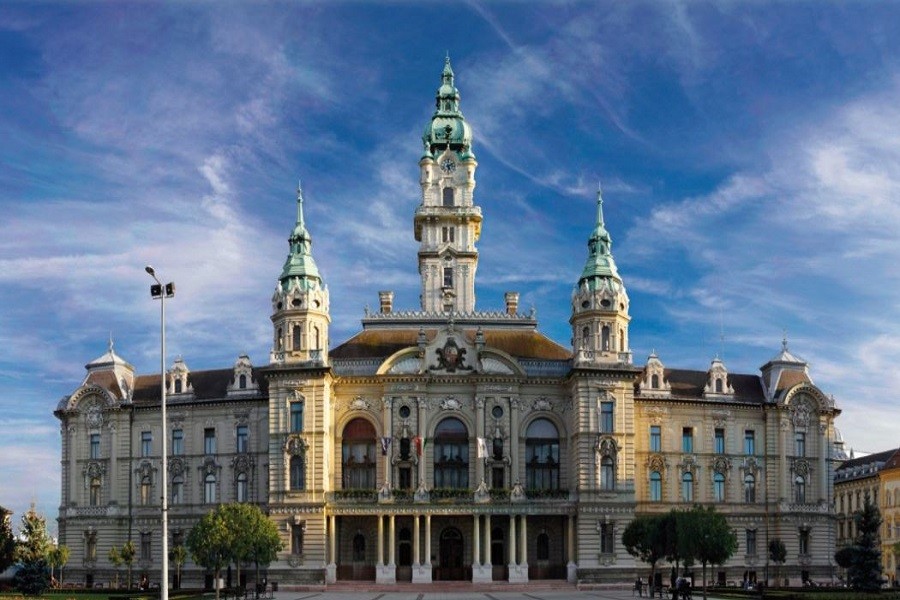
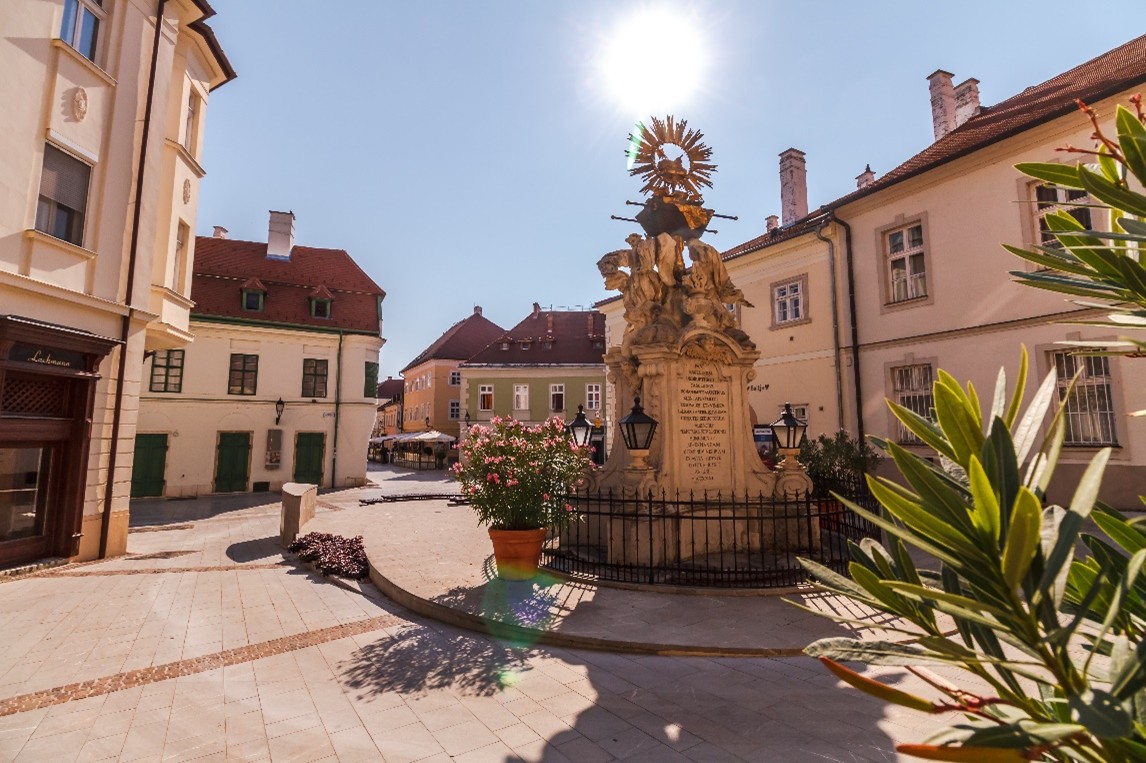
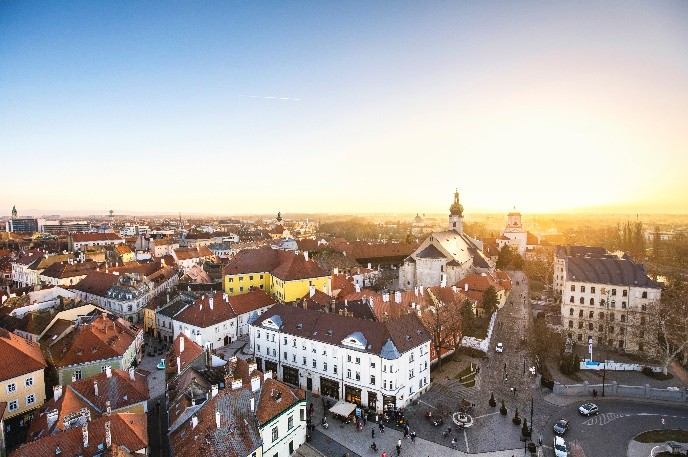
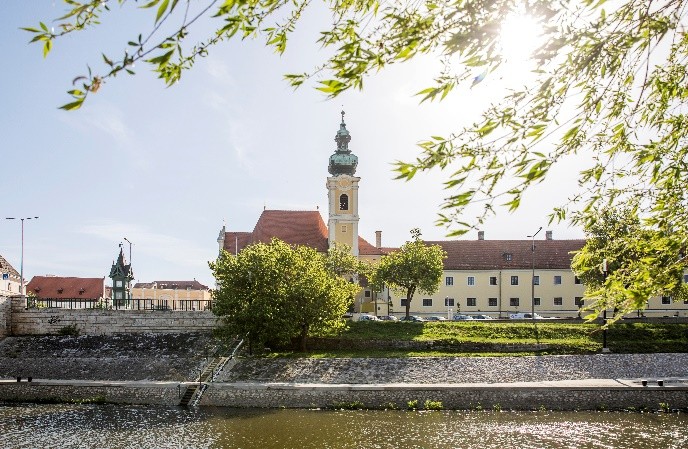
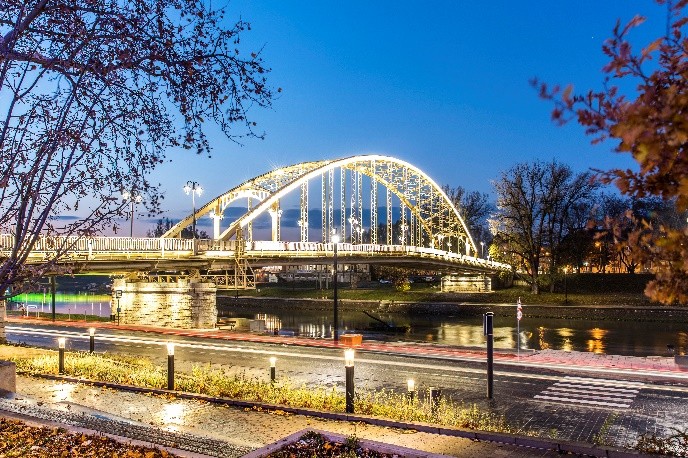
Győr’s bustling city center is home to many valuable monuments. The eclectic style of the City Hall is a captivating sight and a great starting point for a stroll around the city center. Strolling along Baross Street, the city’s pedestrian street, you can enjoy refreshing drinks in cozy cafés. The modern theatre building, with its mosaic by the famous op-art artist Victor Vasarely, is a landmark in the city center. The theatre is famous for its ballet company, and every year they organize the Hungarian Dance Festival in June.
The heart of the city center is Széchenyi Square, which offers a rich programme of events all year round. In summer it is the venue of festivals (Baroque Wedding, Chocolate Festival, Wine Festival…), in winter it is the venue of the Advent craft fair. Last but not least, the architecture is magnificent, as the city’s most important Baroque buildings are located here. The Benedictine church, its convent and the grammar school, where young generations are still being educated, are also worthy of mention. The Benedictine monks not only have baroque buildings to welcome their guests, but also their own beer bar where you can taste their beers and even drink them yourself.
The ecclesiastical center of the town is the Cathedral Hill, where the Bishop’s Castle and the Cathedral buildings dominate the skyline. The tower of the Bishop’s Castle offers a magnificent view of the city, while in its cellar there is an interactive exhibition about Blessed Vilmos Apor, the Bishop of Győr who was martyred in World War II. The interior of the Cathedral is characterized by Baroque splendor, and its Gothic chapel houses the hermitage of the skull bone of our 11th century King St. Lazarus, one of the most important relics of the Hungarians after the Holy Crown.
In fine weather, you can take pleasant walks along the river banks or enjoy a typical Győr drink, the fröccs, a mixture of wine and soda water. The father of soda water was a Benedictine monk, Ányos Jedlik, who developed his invention in Győr. Come to our city and experience the atmosphere of the past in the pulsating present!
For more information about Széchenyi István University click here.
Source: Admissions – About Győr (sze.hu)